




In our recent podcast episode, Jess and Wendy put ChatGPT to the test in a way many people with diabetes probably already have. Jess typed “build me a 7 day diabetes meal plan” into ChatGPT without adding any personal details, exactly how someone who was newly diagnosed might. Then they walked through the meal plan together to see how well it held up. The result looked polished at first glance. The meals sounded balanced. The formatting was clean. Yet once they looked closer, they found several clinical concerns that could easily be missed.
Here’s the bottom line: AI can absolutely be a helpful starting point for gathering ideas or organizing information. The challenge is that it doesn’t know you. It doesn’t know your medications, your blood sugar patterns, your lab work, your cultural food preferences, your schedule, or what you actually enjoy eating. Those details are what turn a generic meal plan into one that helps you manage your blood sugar in a way that feels realistic and sustainable.
Are you living with diabetes or prediabetes and want support from a Registered Dietitian Nutritionist covered by insurance? Take our intake quiz to sign up for 1:1 nutrition counseling with our culturally humble, weight-inclusive Diabetes Dietitians. Our 12-week program helps you lower your A1c and improve your relationship with food. Most insurance patients pay $0 out of pocket! Start your journey to better health today.

What ChatGPT actually produced
Jess read the highlights on air so let me walk you through what the plan included:
- Monday breakfast: Greek yogurt, chia seeds, blueberries, one boiled egg. Monday dinner: baked salmon, steamed broccoli, half a cup of quinoa.
- Tuesday breakfast: oatmeal with cinnamon, walnuts, half an apple. Tuesday dinner: stir-fried tofu or chicken, mixed vegetables, half a cup of brown rice.
- Wednesday dinner: grilled shrimp, zucchini noodles, roasted Brussels sprouts.
- Thursday breakfast: a smoothie with spinach, protein powder, almond milk, frozen berries.
- Sunday dinner: turkey meatballs, spaghetti squash, no-sugar-added marinara.
At the bottom, the plan recommended aiming for 30 to 45 grams of carbohydrates per meal, filling half your plate with non-starchy vegetables, choosing whole grains, and avoiding sugary drinks. It even offered to customize: vegetarian, budget-friendly, printable grocery list, type 1 versus type 2.
Sounds thorough. Wendy’s first reaction when Jess sent it to her was that it looked pretty good. “If you didn’t know what to look for,” she said, “you’d think you just saved yourself a copay.”
The clinical gaps hiding under the pretty formatting
It assumed you eat 2,000 calories
The plan was built on a generic 2,000-calorie baseline without asking a single question about you. Your height. Your weight. Your age. Your activity level. Whether you’re on a GLP-1 (semaglutide or tirzepatide, medications that significantly reduce appetite). A 5’2″ woman on a GLP-1 who’s struggling to tolerate much food is going to look at this plan and feel completely overwhelmed by how much food is being asked of her. Someone who’s very active and taller might actually need more than 2,000 calories and would be underfeeding themselves following this.
AI meal plans built without individual metabolic data are clinically incomplete by definition. They’re writing a prescription without examining the patient.
It had no cultural relevance
Look at that meal list again. Quinoa. Zucchini noodles. Spaghetti squash. Brussels sprouts. Turkey meatballs. It’s not that these foods are wrong. It’s that they represent a very specific kind of “healthy eating” aesthetic that doesn’t reflect how most people actually cook or what feels like home.
Wendy put it plainly: “I cook a lot of root vegetables. I like my leafy greens cooked. I do a lot of stews. None of that is in here.” For people from Latin, Caribbean, African, South Asian, or West African backgrounds, a meal plan this stripped of cultural context is not just unappealing. It’s disconnected from how many people actually eat and enjoy food. You’re not going to build a sustainable way of eating by making someone feel like their cultural foods are the problem.
Our dietitians see this all the time. A client comes in after trying to follow a “perfect” meal plan they found online, only to stop using it a couple of weeks later because it doesn’t look anything like the foods they actually enjoy or the way they normally eat. Then they start to feel like they failed. In reality, the meal plan was never built for them in the first place.
Carb counting advice without context is overwhelming
“Aim for 30 to 45 grams of carbs per meal.”
That sounds helpful until you stop and think about it. What does 30 grams of carbohydrate actually look like on your plate? For most people, that’s hard to picture, and that’s completely understandable.
A number by itself doesn’t tell you how to build a meal with the foods you already enjoy eating. It doesn’t explain why that range might be helpful or how your needs could change if you’re taking insulin, using a GLP 1 medication, exercising more, feeling stressed, or noticing different blood sugar patterns. Those details matter, and they’re one of the reasons nutrition recommendations aren’t one size fits all.
It didn’t account for medication at all
This one is a genuine clinical risk. If you’re on insulin, your carbohydrate intake needs to align with your dosing. Too few carbs at certain meals can cause overnight hypoglycemia (low blood sugar) or cause your liver to overcompensate by releasing stored glucose, which pushes up your fasting numbers. A meal plan that doesn’t know you’re on insulin cannot safely make carbohydrate recommendations.
Same goes for GLP-1 medications, SGLT2 inhibitors, sulfonylureas. Each one changes how your body responds to food. AI doesn’t ask. It just generates.

Specific meals that missed the mark
Tuesday breakfast: oatmeal, cinnamon, walnuts, half an apple
Oatmeal is a carb. Apple is a carb. Walnuts add fat, which helps, but where is the protein? Cinnamon is not a protein. This breakfast is what we’d call naked carbs: carbohydrates eaten without enough protein to buffer the glucose response. For many people, this meal leads to a crash by 10 a.m. because it doesn’t provide lasting satiety.
What would our dietitians actually suggest? Keep the oatmeal if you love it. But add eggs on the side, or use Greek yogurt as your base instead of water. You can still have your oatmeal flavor profile with real protein powering it. That’s power pairing, and it changes the whole glucose response.
Wednesday dinner: grilled shrimp, zucchini noodles, Brussels sprouts
This plate looks beautiful. Lots of color, lots of vegetables. But there is almost zero carbohydrate in this meal. Zucchini noodles are a vegetable. Brussels sprouts are a vegetable. Shrimp is a protein. Your body needs carbohydrates, even with diabetes. Cutting them out entirely is not the goal.
Here’s what actually happens for most people who eat this kind of dinner: they feel okay for a bit, then they’re hungry an hour later and end up eating high-carbohydrate snacks in the evening, often quickly and mindlessly. For people on certain medications, too few carbs at dinner can also trigger overnight lows or elevated fasting glucose as the liver overcompensates by dumping glucose into the bloodstream.
If you want zucchini noodles, have them. Just mix them with actual pasta instead of replacing it. Add a small portion of brown rice or a piece of whole grain bread on the side.
Sunday dinner: turkey meatballs, spaghetti squash, marinara
Again, very low carb. That’s two nearly zero-carb dinners in one seven-day plan. For many patients managing blood sugar with medication, this is a real clinical concern that the plan doesn’t flag at all. Because it doesn’t know you’re on medication.
Thursday breakfast: the smoothie
Smoothies are not the enemy. Jess has one almost every morning. But here’s what the AI plan missed: liquid meals often digest faster than solid food, which means the glucose from your smoothie may hit your bloodstream more intensely than eating the same ingredients whole. Protein powder is a good start. But adding fat is the move: almond butter, avocado, hemp seeds, chia seeds, walnuts. Fat slows absorption and helps buffer the glucose response in a way protein powder alone doesn’t.
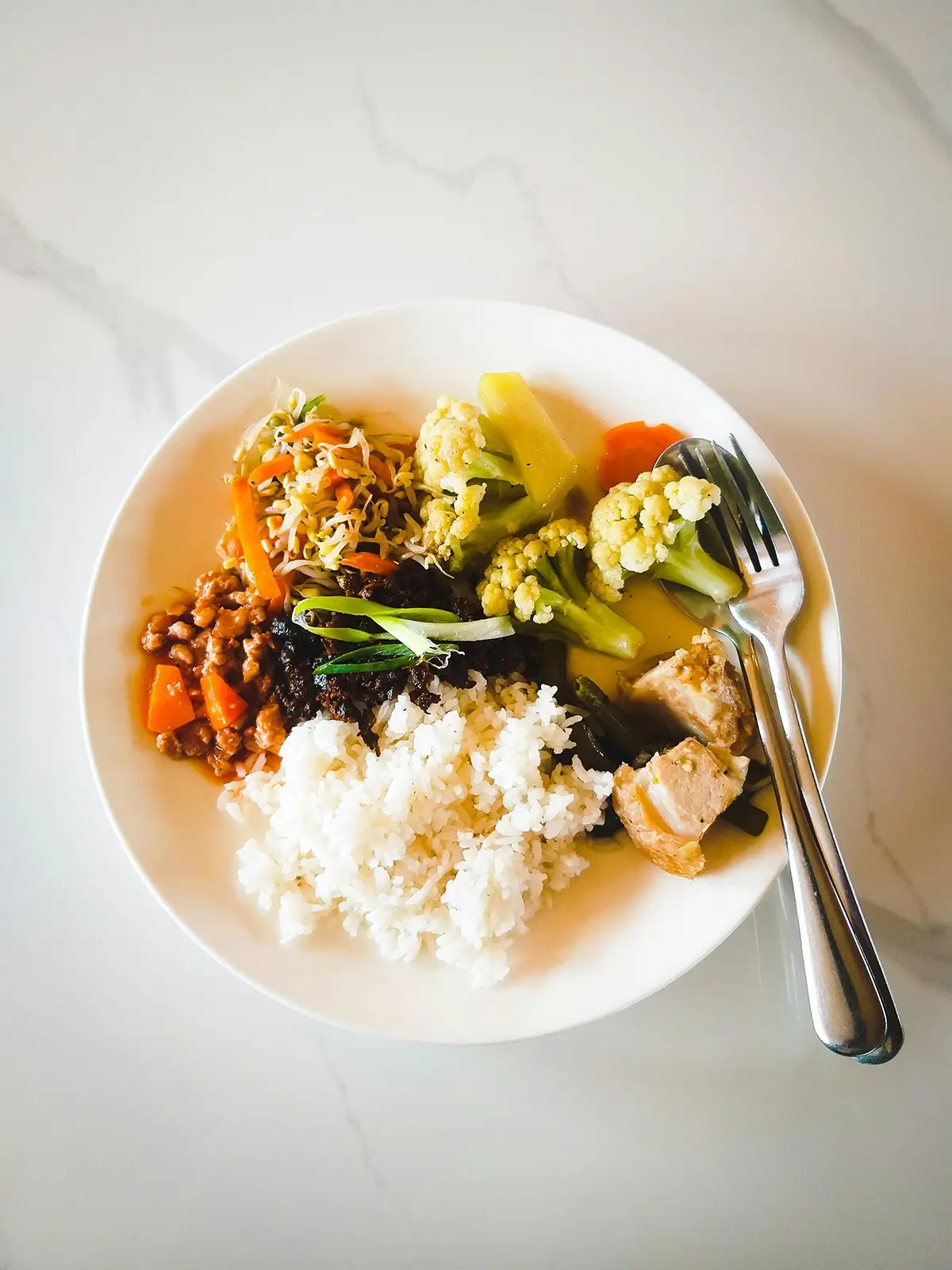
The deeper problem with meal plans in general
Even a perfect meal plan doesn’t work if nobody follows it. Wendy said it directly: research on this is overwhelming. Adherence to prescribed meal plans drops dramatically after the first two to three weeks. Most of their patients, in real clinical experience, don’t follow them either.
Real life happens. You have a hard week. You’re traveling. You’re exhausted. You reach for something comforting. None of that makes you a failure. It means a static seven-day grid was never the right tool to begin with.
What actually helps: understanding the principles well enough that you can make good-enough decisions without a plan. Knowing that you can have rice if you pair it with protein and fat. Knowing that a snack of just crackers is going to behave differently in your body than crackers with cheese. That kind of flexible, internalized knowledge is what our dietitians build with clients over time. It doesn’t come from a meal plan PDF. It comes from someone knowing your life and helping you think through it.
What a session with a Diabetes Digital dietitian actually looks like
This is the question Jess and Wendy get asked constantly: what even happens during a dietitian visit? People assume it starts with food. It doesn’t.
It starts with your life. What time do you wake up? What does your work schedule look like? Who does the cooking? What’s already in your kitchen? What do you love eating? What foods feel like home? What have you already tried? What did your doctor tell you when you were diagnosed and how did that land?
Then we look at your labs together. Not just your A1C (your average blood glucose over three months), but your fasting glucose, your lipid panel, your kidney function. The full metabolic picture. Because what’s going on with your kidneys changes the carbohydrate recommendations. Your lipid panel changes which fats we prioritize. Your A1C alone doesn’t tell us enough.
Then we factor in medications and timing. Insulin requires dosing alignment with meals. GLP-1 medications suppress appetite, which completely changes the volume and timing of eating. Sulfonylureas require consistent carbohydrate intake to avoid lows. AI doesn’t ask about any of this. It just builds a plan.
And sometimes, as Wendy pointed out, the issue isn’t food at all. Grief, divorce, financial stress, fertility struggles, poor sleep, a job you hate: all of these raise cortisol levels. Elevated cortisol (the body’s primary stress hormone) directly worsens insulin resistance, which raises blood sugar independently of anything you eat. A dietitian who’s paying attention will catch that and help you coordinate care. A meal plan won’t.
“We create a plan that we build with you, not for you.” — Jess, Diabetes Digital Podcast
A client story
A client came to me a few months ago who had spent three weeks following an AI-generated meal plan to the letter. She was proud of herself for being consistent. But her numbers hadn’t moved and she was miserable eating food that felt nothing like her. Her family is Haitian and she’d given up her rice, her legumes, her stewed greens because the plan didn’t include them and she assumed they were off-limits.
When we sat down together, we rebuilt her eating around the foods she already loved. Diri kole (rice and beans) with a bigger portion of protein alongside it. Legume stew with added sardines for anti-inflammatory fat. Her regular breakfasts with a boiled egg added. Within six weeks her A1C had moved and she told me she finally felt like she could actually do this long-term. Nothing was taken away. We just dressed it up.
That’s the difference.
Book your first visit with a registered dietitian
AI meal plans are free and sound great. But they don’t know you. We do. Our dietitians build your plan around your labs, your medications, your cultural foods, your schedule, and your actual life. We see clients across 40+ states, accept most major insurance plans including Medicaid in California, and 95% of patients pay nothing out of pocket. Half of our team are native Spanish speakers. All visits are telehealth.
Sign up to work with a Registered Dietitian here. We’ll verify your insurance benefits before your first visit so there are no surprises. Or call or text us at 415-651-4333. A real person answers.
Frequently Asked Questions
Is an AI-generated diabetes meal plan safe to follow?
An AI meal plan is not inherently dangerous, but it carries real clinical risks if you’re on diabetes medications like insulin or sulfonylureas, because it doesn’t account for dosing alignment, carbohydrate timing, or your individual metabolic needs. It’s fine as a general starting point for meal ideas, but it should not replace guidance from a registered dietitian who knows your labs and medications.
Why do most people stop following diabetes meal plans after a few weeks?
Research shows that adherence to prescribed meal plans drops significantly within the first two to three weeks. The reason is usually that static plans don’t account for real life: travel, stress, family dynamics, food preferences, cultural foods, and the natural variation in hunger and schedule. A more sustainable approach is building the skills to make flexible, informed food choices rather than following a grid.
Can I eat rice, tortillas, or other cultural foods if I have diabetes?
Yes! Cultural carbohydrates are not off-limits. The clinical focus is on power pairing them with protein and fat to buffer the glucose response, not eliminating them. A registered dietitian who practices with cultural humility will build your plan around these foods, not around replacing them with zucchini noodles.
What does a dietitian visit at Diabetes Digital actually cover?
Sessions start with your life, not your food log. Your dietitian will ask about your schedule, who cooks, what you love eating, your stress levels, your medications, and your labs. Then you’ll build a realistic nutrition approach together based on all of that, not a generic plan handed down to you
Does Diabetes Digital accept my insurance?
Diabetes Digital works with most major insurance plans across 40+ states, including Medicaid in California. Most patients pay zero out of pocket. You can check your benefits at diabetesdigital.co/start before committing to anything.
Transcript
Welcome back to another episode of the Diabetes Digital Podcast presented by Food Heaven.
I’m Jessica Jones.
And I am Wendy Lopez we are both registered dietitian certified diabetes educators and the Co founders of diabetes digital which is a telehealth nutrition practice.
0:16
We help people with pre diabetes and diabetes manage their blood sugar and we are covered by insurance so most of our patients actually pay 0 out of pocket.
Yeah, so if you want to sign up, head on over to our website, diabetesdigital.co.
And the whole process is very easy, takes a couple of seconds, and we’ll verify your benefits.
0:36
In today’s episode, we did something fun.
So I went to ChatGPT and I typed build me a seven day diabetes meal plan.
I gave it no other context.
I put it in just like maybe one of our patients would, you know, a person who is maybe recently diagnosed with diabetes and wanting help with their nutrition.
0:57
And Wendy, like, tell me what you thought when you first looked at what ChatGPT spit out.
Yeah, so just sent me the meal plan and honestly it looks pretty good.
Like it had grilled salmon, quinoa, Greek yogurt with chia seeds.
1:14
Like all foods that I’m like, OK, that actually sounds like very well balanced and and healthy.
And if you didn’t know what to look for, you’d think that you just saved yourself a co-pay or a visit to a dietitian.
And this is exactly why we wanted to do this topic.
1:32
Break this down today, have a little fun, but also hopefully there’s like some teaching moments because there are so many people using AI to build their meal plans.
I’ve even done it in the past myself, but there are clinical problems hiding under all of that pretty ChatGPT formatting, so we’re going to get into that today.
1:52
Welcome to the Diabetes Digital Podcast.
I’m Wendy.
And I’m Jess, and we’re best friends, registered dietitians and diabetes educators.
Through our telehealth platform, Diabetes digital.co, we offer accessible and personalized virtual nutrition counseling for people with diabetes and pre diabetes.
2:09
Visit diabetesdigital.co.co to book your first appointment.
We accept insurance and offer affordable self pay options.
Now let’s get into today’s episode.
So the first thing I want to do is read some of the key highlights from the plan on air so that listeners can follow along.
2:27
So just try to visualize this.
So for Monday for breakfast, the meal plan had Greek yogurt, unsweetened chia seeds, blueberries, one boiled egg.
For dinner it had baked salmon, steamed broccoli, half a cup of quinoa.
2:44
That was Monday.
Tuesday for breakfast there was oatmeal with cinnamon, walnuts, half an apple and then for dinner it was stir fry tofu or chicken with mixed veggies, half a cup of brown rice.
Wednesday dinner was grilled shrimp with zucchini noodles, roasted Brussels sprouts and then Thursday for breakfast, it was a smoothie with spinach, protein powder, almond milk, frozen berries.
3:12
And then Saturday dinner was baked cod, asparagus, small roasted sweet potatoes and then Sunday dinner with Turkey meatballs, spaghetti squash and no sugar added marinara.
So the bottom of the plan, it says to aim for 30 to 45 grams of carbs per meal and to fill half of your plate with non starchy vegetables, choosing whole grains, also avoiding sugary drinks and drinking plenty of water.
3:39
Then it offers to customize the meal plans.
You can make it vegetarian, you can make it budget friendly.
You can do a printable grocery list.
There’s also customizations for type one versus type 2 diabetes.
So it sounds very comprehensive and like it did cover everything, but here is what it missed.
3:59
So Wendy, do you want to go over what the meal plan didn’t include or some of the holes in this meal plan?
Yeah.
So the biggest 1 is that it assumed that this person was eating 2000 calories, which is, I think just like the generic caloric intake that I would say a lot of online sources use.
4:19
But they never took into account things like height, weight, age, activity, metabolic rate.
To give you an example, like let’s say a woman who’s 52 and she’s on a GLP one, right?
Because a lot of people are on GLP ones now and maybe they have reduced appetite and there’s no way that they’re going to be able to tolerate 2000 calories.
4:44
And same for someone who is very active.
Like maybe they have a different height, they have a different way, they’re doing intense exercise.
They might even need more calories right then like the 2000 calorie plan.
Another thing is that just by like hearing just talk about these meals, I’m like, I wouldn’t eat any of this.
5:08
It’s the kind of thing where it sounds good in theory, but it’s not really taking into account personal preference and also culture.
Like a lot of the foods that I typically make at home.
For example, like for carbs, I cook a lot of root vegetables.
5:23
I like my vegetables to be cooked like my leafy green vegetables.
I do a lot of stews.
None of that is incorporated in this, which I think for people from diverse cultural backgrounds, that could be a major challenge.
5:39
And even like saying the whole, like, oh, well, 30 to 45 grams of carbs, like most people don’t know how to visualize that.
And so it could become overwhelming, like, Oh my God, now I have to count my carbs.
I don’t really know what that means if you’re on medication like there is not a lot of information on there about how medication fits into your meal planning as well.
6:02
And so I think the biggest issue with this and how it’s laid out is that there is no customization, there’s no personalization.
There’s asking about like, OK, what’s going on with you.
And of course, you can always put those things into AI because you’re kind of like feeding the information that you’re getting out of it.
6:21
So you could put like, OK, this is my height, this is my weight, this is my culture.
But I do think that this conversation is very nuanced.
And that’s where having a human behind the recommendations is going to be helpful, especially a human being that has an understanding of culture, how it plays into the decisions that you make when it comes to your nutrition.
6:45
Yeah, and not to mention too, it’s just the intuitive eating of it, all right?
There might be days when you want more food, less food.
It doesn’t talk anything about like your hunger, fullness potential, emotional eating, stress eating.
7:00
It just is not looking at you from a holistic perspective, meaning like looking at the intersections of all of your life.
And so that’s a real problem.
Also, I wanted to break down some of the specific meals and the holes.
7:16
So, for example, Tuesday breakfast, it says oatmeal.
OK, oatmeal, you know, can be great for certain things.
Fiber, right?
Cinnamon, that can be great for blood sugar.
Walnuts.
Half an apple sounds healthy.
But The thing is, oatmeal’s a carb.
7:32
Apple is a carb.
Walnuts add some fat.
But where’s the protein?
Cinnamon’s not a protein.
So what’s gonna happen with this meal?
Likely is somebody might have this, they’re going to potentially have a crash by 10:00 AM because it’s not a ton of balance given protein.
7:52
And then that might backfire, right?
So maybe what you could do for this particular meal, just to share what I might say with clients is maybe you do like more of a savoury oatmeal and you add eggs on the side.
8:08
I know that when I have oatmeal, I need to have some solid protein like eggs with it.
Or maybe if you like Greek yogurt, it’s OK if you don’t, but you can add some Greek yogurt as the base and that’s going to help you get that protein to make it more satiating.
8:24
And so it’s still the same idea, but you might have a different glucose response.
Now let’s go through Wednesday’s dinner.
There’s a grilled shrimp, zucchini noodles, Brussels sprouts.
So I’m sure this plate looks very pretty.
Lots of greens.
8:40
However, what is missing there is 0 carbohydrate zucchini noodles are vegetables, not starch.
And it’s very funny because we often will have a lot of patients say like I did zucchini noodles, I did cauliflower rice.
And I’ll always say, oh, tell me more about why you made that choice.
8:56
And what I’m getting out with patients is getting them to realize if this is true for them.
Maybe it’s not.
But for 99%, it is like you didn’t have any car with that meal and you probably were hungry very shortly after and ended up crashing and seeking out like higher carbohydrate foods.
9:15
So I don’t recommend things like zucchini noodles as your starch.
Like it’s one thing if you maybe want to mix it and have your noodles with some zucchini and that’s your vegetable, but you still have your starch.
Like that’s totally fine, but just replacing don’t recommend.
9:32
Also, for people on certain medications, too few carbs at dinner can cause overnight lows or elevated fasting glucose as the liver overcompensates.
So the problem with this plan is it doesn’t flag this because it doesn’t know you and your medications and what’s going on.
9:50
And now Sunday dinner, so this dinner includes Turkey meatballs, spaghetti squash, marinara.
Again, almost no carb.
So that’s two very low carb dinners in one week.
That could be an issue for many patients and the AI just fell short there.
10:06
So another thing with the smoothies, so a lot of people love their smoothies, including me.
I have a smoothie almost every morning.
And one thing that the smoothie did include was protein powder, which great, it has a protein source.
But I always like people to kind of just test smoothies and see, like, do you find that the liquid meals for you digest faster, which is the case for many people, And it might elevate your blood sugar more intensely than eating those same ingredients whole.
10:37
So I typically recommend with smoothies, not just adding the protein, but also adding fat to help slow the absorption.
So you can add things like nut butter, avocado.
I love adding walnuts, seeds, hemp seeds, chia seeds, flax seeds.
10:54
And this is again the nuance that AI can’t give you.
And even me as a dietitian sometimes I’m like, let me see what can AI tell me for like some meals I need help meal planning and I’m just always completely underwhelmed even when I give it.
Like when he said feeding it all the information preferences, it still is so basic with what it gives me and I never ever typically end up doing any of the meals that it says because it just misses the mark.
11:20
Yeah, 1000% same.
Like I’ve done, I’ve done the AI meal plans and I’m like it.
It always sounds great.
They sound great.
They look great, very organized.
And even me as a dietitian, like I don’t actually implement it because it’s just information that looks good.
11:37
And it’s the same with anything, right?
Mental health advice, you can put it all into AI and be like, what should I do?
And it all sounds great.
But the real difference to making changes that last is like having someone who’s going to help guide you through that process, answer any questions and not just anyone, but like a professional and is going to help hold you accountable.
12:01
I will say with meal plans, in our experience, most people don’t end up following them.
They don’t stick to them.
And the research on this is overwhelming, like adherence.
So prescribed meal plans drops off dramatically after the first two to three weeks.
12:16
So in the beginning, you know, you might follow it, and then within a few weeks, a lot of people fall off.
And it doesn’t mean that there’s something wrong with you or that you’re having an issue making changes to your nutrition or whatever it is.
It’s just that real life happens and it’s just not a practical approach, right?
12:36
I think that based on our years of experience and seeing what actually does work, it’s really asking yourself the deeper questions on like what are the obstacles that are in my way?
What is happening around me?
Are there deeper issues around food or like what are the blocks?
12:53
Sometimes it’s just like having the education and then you’re able to make better decisions.
But there’s constant changes happening in our life.
And it is nice having an objective person who is trained in nutrition and tell you like, OK, just give you that support and education along the way as you’re navigating those changes and you feel more confident on making eating choices on your own because the goal is to not feel super stressed and not have to feel like, Oh my God, you need this elaborate plan to be able to eat healthier.
13:23
It’s for it to become a little more intuitive where you’re just like, OK, I feel very confident in making choices, food choices, and it’s not something that I have to think about so much.
Exactly.
And so I wanted to talk a little bit about one of the most common questions we get asked, especially now as we call many of our referred patients to schedule them.
13:47
And I always say like, hey, what questions do you have?
And they always want to know what does a session look like with a dietitian?
They have no idea.
So with diabetes digital, we actually don’t start with food food.
We start with your life.
So what time do you wake up?
What is your work schedule?
14:03
Who cooks?
What’s in your kitchen?
What do you like?
What foods feel like home?
What have you already tried when it comes to your health and nutrition?
What do you do for work?
How do you feel about it?
What did your doctor tell you about your diagnosis?
So that’s where we start.
It’s not like tell me everything you ate today.
14:21
We also factor in medications and timing.
So if you’re on insulin, for example, that requires dosing alignment, right?
Or if you’re on AGLP 1, you might.
We have a suppressed appetite and that’s a totally different plan than someone who’s always hungry.
We also look at labs together, not just your A1C, which is your average glucose over three months, but also your fasting glucose, your lipid panel, your kidney function.
14:43
We really want to look at the full metabolic picture because that will change the recommendations.
One thing that is unique about working with many dietitians as well is we create a plan that we build with you, not for you.
So if you love having, you know, your rice and your beans and whatever it is every night, then we’re going to work with you on that.
15:09
And so it’s not really about like us having all the answers.
It’s really like you sharing who you are and maybe we’re giving suggestions if you want them and we’re working with you to create a plan.
Yeah, and sometimes the issue is not food at all.
15:27
We see this all of the time with our patients.
They might be struggling with grief, with stress, with financial issues, poor sleep patterns.
They’re going through a divorce, they’re going through fertility issues, like just all of the things that come up and that is having more of an impact on their overall well-being than nutrition.
15:50
And so a dietitian can help you coordinate care so you’re getting the right support if you have a lot going on at the moment and it’s affecting your food choices.
All of these things also affected cortisol levels, which if you have insulin resistance, can really affect your blood sugars.
16:07
And that’s something that AI is probably not going to pick up on or make that connection.
That’s something that a trained professional in nutrition is going to be able to do and ask more about.
We love, well, I’m not going to say we love AI, but we use AI.
16:24
We leverage AI and we see how it can be helpful in different settings, like even from a business standpoint, like we use it for so many different things.
It has its pros and cons, right?
But it’s like with all of the evolution that’s happening in technology is something that we all need to stay on top of just to see like, how does this affect us?
16:44
And so we’re not like anti using AI even when it comes to like nutrition and things like that.
Like if you’re looking for recipe ideas, if you’re like, oh, I have a quick question.
I’m always, I think putting my health questions into, you know, AI, but then I do follow up with my doctor like, hey, what are your thoughts on this?
17:03
So I don’t have my AI as my doctor.
Like it’s not a replacement.
Like having those prompts again, they sound great.
Like, OK, yeah, give me 5 high protein snacks that I can make another 5 minutes it it’ll come out beautifully.
But having someone in your corner who makes adjustments based on how you’re feeling, based on your labs, based on the medications you’re on, that is going to be so much more valuable and it’s really going to push you further in terms of the progress that you’re making.
17:37
Yes, and if AI could do what we do, it would take insurance, it would have outcomes data supporting that it works, but it can’t.
And that’s where we come in as dietitians.
That’s why we exist.
And I pray that we have job security for the years to come.
17:54
And so Diabetes Digital, we offer personalized insurance covered, culturally responsive care from people who know you, your name, your labs, what you love, what you hate, your kitchen, all the things.
The great thing is also 95% of our patients pay nothing out of pocket, which is awesome.
18:13
And I know there are the AI apps coming for our jobs, there really are.
But I don’t know, I just feel like AI cannot compete.
And many of those apps charge 20 to $30.00 a month for generic advice.
So why not use the benefit you already pay for with your insurance or your Medicare and if you’re in California, Medicaid.
18:34
So go to diabetesdigital.co/start.
We’ll verify your insurance benefits before your first visit so there’s no surprises.
Or you can text us at 415-651-4333 or call us.
A real person answers, not AI.
Half the time it’ll be Wendy answering.
18:52
And rate US on Spotify or Apple Podcast.
If you like this episode, it takes 2 seconds and it helps other people find us.
All right y’all, we’ll catch you next time.
Bye.
Thanks for joining us for today’s episode.
If you’re interested in nutrition counseling with one of our expert dietitians to help improve your pre diabetes or diabetes, visit us at diabetesdigital.co.
19:14
Also, if you found our conversation helpful, do us a favor and rate and review this podcast on iTunes, plus share with someone who might find this helpful.
You can also connect with us on Instagram at Diabetes Digital.
Dot Co and TuneIn every Wednesday for practical, inclusive, and culturally humble diabetes insights.
Clinical Sources
- American Diabetes Association Standards of Care in Diabetes, 2025: https://diabetesjournals.org/care/issue/48/Supplement_1
- Franz MJ, et al. “The evidence for medical nutrition therapy for type 1 and type 2 diabetes in adults.” Journal of the Academy of Nutrition and Dietetics. 2010;110(12):1852–1889. DOI: https://doi.org/10.1016/j.jada.2010.09.014





Leave a Reply