




In our recent podcast episode, Jess and Wendy dove into something they’ve wanted to address for a long time: the connection between your menstrual cycle and your blood sugar. It affects the majority of their patients, and almost nobody brings it up in a clinical setting. If you’ve ever had a week where your numbers were suddenly harder to manage and you hadn’t changed a single thing, this one is for you.
So, can your period affect your blood sugar? Here’s the direct answer: Yes, your menstrual cycle does directly affect how your cells respond to insulin. This means your blood sugar will naturally run higher in the two weeks before your period, regardless of what you eat. This is not a willpower problem. It’s your endocrine system doing exactly what it’s supposed to do.
Are you living with diabetes or prediabetes and want support from a Registered Dietitian Nutritionist covered by insurance? Take our intake quiz to sign up for 1:1 nutrition counseling with our culturally humble, weight-inclusive Diabetes Dietitians. Our 12-week program helps you lower your A1c and improve your relationship with food. Most insurance patients pay $0 out of pocket! Start your journey to better health today.

What your hormones are actually doing to your blood sugar
Your menstrual cycle is roughly 28 days. Throughout that cycle, two hormones, estrogen and progesterone, are constantly shifting. They don’t just affect reproduction. They directly affect insulin sensitivity (how well your cells respond to insulin and use glucose for energy).
Here’s the quick physiology. When you eat carbohydrates, whether that’s rice, bread, fruit, or pasta, they break down into glucose. Glucose is not the enemy. Your cells and muscles need it to function. Insulin is the hormone that acts like a key, opening the door so glucose can actually get into your cells. In someone with insulin resistance (when your cells stop responding efficiently to insulin), that key gets a little stuck. Glucose builds up in the bloodstream instead, and numbers climb.
Now layer your cycle on top of that. Estrogen improves insulin sensitivity. Progesterone increases insulin resistance. And those two hormones are fighting a rotating battle inside your body every single month.
The follicular phase: the two weeks when things feel manageable
Day one of your period through ovulation. Roughly the first two weeks. Estrogen is rising during this phase and it’s working in your favor. Your cells are more responsive to insulin, which means glucose is getting into where it needs to go more efficiently. Your numbers during this phase will likely sit closer to target. You might feel like you’ve finally figured everything out.
You haven’t cracked a secret code. You’re just in an estrogen-dominant phase. Enjoy it. This is a great window to experiment with new recipes or foods you’ve been nervous to try, because your glucose response will be more forgiving. If you have a CGM (continuous glucose monitor) or a glucometer, this is a good time to establish your personal baseline.
This is where it gets harder. After ovulation through your next period, roughly the last two weeks, progesterone rises. And progesterone increases insulin resistance. That means your blood sugar will run higher even if you’re eating the exact same foods at the exact same times.
The three to seven days right before your period are typically the peak of this. When progesterone is at its highest, insulin resistance is at its highest too. You might notice:
- Fasting glucose suddenly 10 to 15 points higher than your normal
- Post-meal numbers running 20 to 30 points above what you usually see
- Cravings for bread, sweets, pasta, carb-heavy comfort foods hitting hard
None of this is you doing something wrong. Your endocrine system is running its programming.
This is not a willpower problem. This is not a discipline problem. This is your endocrine system doing what it does. — Jess, Diabetes Digital Podcast
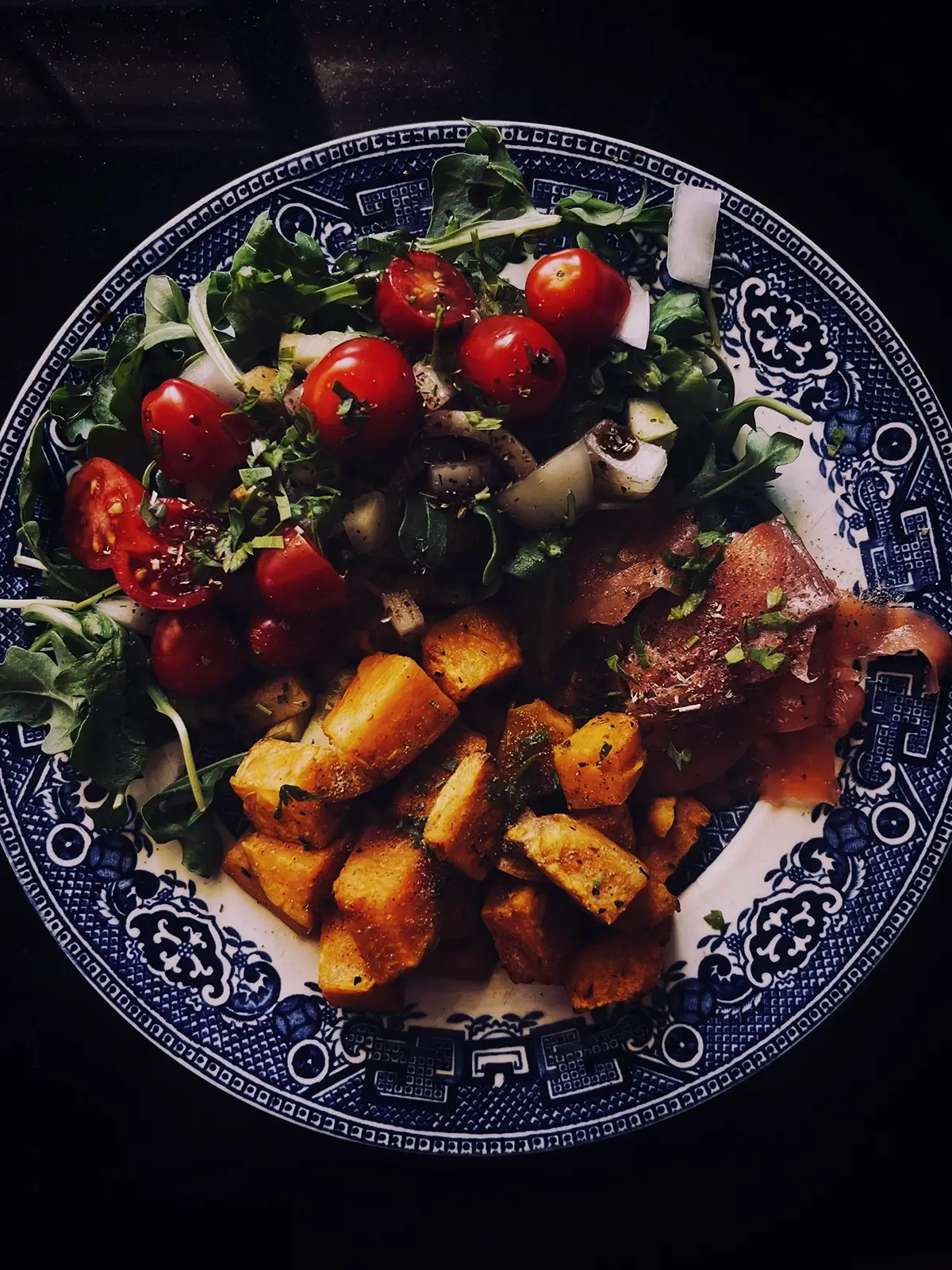
What to eat during the luteal phase (without restricting anything)
The cravings during this phase are your body asking for serotonin. That is real. And it’s okay to eat the foods you’re craving. The move is not to white-knuckle through it. The move is to buffer.
Slightly increase protein at every meal. Not dramatically. If you usually have a four-ounce piece of salmon at lunch, go up to six ounces. Add some beans to your plate. Having a little more protein keeps you more satisfied and helps stabilize your glucose response when insulin resistance is running high.
[Image: plate showing a luteal phase meal: six-ounce salmon fillet, black beans, leafy greens, and a side of brown rice — alt text: “luteal phase meal for blood sugar management with protein-rich foods and anti-inflammatory ingredients”]
Lean into anti-inflammatory foods. Progesterone-driven insulin resistance also triggers temporary inflammation in the body. Foods that work against that: fatty fish like salmon and sardines, leafy greens, berries, ginger, turmeric, walnuts, and almonds. These aren’t magic. But our dietitians see this daily: clients who consistently eat these foods during their luteal phase report smoother numbers and less severity with symptoms.
Power pair your cravings instead of fighting them. This is the Diabetes Digital philosophy in action. If you want bread, have it with almond butter. Craving chocolate? Dark chocolate with a handful of almonds. Pasta? Include chicken, turkey meatballs, or white beans, and throw some vegetables in the sauce if you can. You’re not restricting the craving. You’re dressing it up so the glucose response is less sharp.
For snacks, skip the naked carbs (a piece of fruit on its own, crackers alone, a handful of cereal). Pair instead: fruit with an egg, Greek yogurt with a spoon of peanut butter and some berries, a small sweet potato with cottage cheese. The fiber and protein buffer the carbohydrate so your body isn’t riding a rapid glucose wave during the phase when it’s already struggling to manage it.
You’re not restricting the craving. You’re dressing it up. — Jenny Fernandez, MS, RD
The advice that’s clinically incomplete: “just eat less sugar around your period”
Telling someone with diabetes to simply “eat less sugar” during their premenstrual phase is, honestly, trash advice. Not because it’s wrong to reduce added sugar in general, but because it completely misses the point. The glucose fluctuations during the luteal phase are driven by a hormone-induced shift in insulin sensitivity, not by a sudden change in your diet. You could eat the same exact thing for 28 days straight and your numbers would still be higher in that two-week window.
Restrictive advice also backfires hard during a phase when your body is chemically pushing you toward higher-carb comfort foods. Telling someone to white-knuckle a low-carb plan while progesterone is flooding their system and serotonin is dropping is setting them up to feel like a failure. That’s not clinical guidance. That’s just ignoring the physiology.
The weight-neutral, evidence-backed approach is to add protein and anti-inflammatory foods to support your body through what it’s already doing, not to punish yourself for a hormonal reality.
Special populations: when this hits even harder
Jess and Wendy specifically called out a few groups on the podcast where this cycle-blood sugar connection is amplified.
PCOS (Polycystic Ovary Syndrome), now referred to as PMOS (Polyendocrine Metabolic Ovarian Syndrome): If you have PMOS, you likely already have some degree of baseline insulin resistance. The luteal phase stacks directly on top of that.
Everything above applies, just more intensely. And because PMOS often comes with irregular cycles, you may not be able to predict your phases by the calendar. Go by symptoms instead: mood shifts, cravings, breast tenderness, bloating. Those are your signals.
Perimenopause: If you’re over 45 and noticing blood sugar swings that seem to come out of nowhere, your hormones are likely the reason. As estrogen becomes inconsistent during perimenopause, the insulin-sensitizing effect it used to provide becomes unpredictable. This is one reason why pre-diabetes and diabetes diagnoses become more common in this age range. It’s not that you suddenly developed poor habits. It’s that your hormonal environment shifted. Diabetes Digital has several episodes on this, so search “perimenopause” on our podcast feed.
Hormonal contraceptives: Some forms of birth control can affect insulin sensitivity and may increase insulin resistance slightly. If you started a new contraceptive and noticed a change in your glucose trends, bring it up with your prescribing doctor. Worth exploring, not worth ignoring.
A client story
One of my clients, a woman in her late 30s managing type 2 diabetes, came to me completely frustrated. She’d been doing everything right: eating balanced meals, walking after dinner, checking her numbers. But every three weeks, without fail, her fasting glucose would climb 12 to 15 points and stay there for about a week. Her doctor had adjusted her medication twice. Nobody had asked her about her cycle.
Once we mapped her glucose data against her cycle, the pattern was immediately visible. We shifted her luteal phase approach: more protein at dinner, a protein-paired snack before bed instead of fruit alone, adding salmon and walnuts a few times a week.
Within two cycles, her luteal phase numbers had come down noticeably and she stopped feeling like her management was broken. Nothing in her medication changed.
We just worked with her body instead of against it.
That’s what this practice is built on.
Final thoughts on eating through your cycle
A note from Wendy on the podcast that stuck with me: for those of you with very intense, difficult periods, the week leading up to your period might be one where you can barely tolerate food at all. Nausea, digestive upset, sensitivity to textures. If that’s you, eat what you can actually tolerate. Don’t stress about protein grams or fiber percentages when your body is in survival mode. And if your periods are debilitating, please talk to your doctor. Painful, unmanageable periods are not something you just have to accept. Get the support you deserve.
If your periods are debilitating, please talk to your doctor. Painful, unmanageable periods are not something you just have to accept.
For the rest of you, start paying attention to the pattern. If you have a CGM, look at your data week by week over a full cycle. You will likely see it clearly. That information is yours, and it puts you in control of decisions that actually account for your biology.
Frequently Asked Questions
Why does my blood sugar go up before my period even when I haven’t changed what I eat?
In the two weeks before your period, progesterone rises and increases insulin resistance. This means your body needs more insulin to move glucose into your cells, and if that insulin isn’t available in higher amounts, glucose builds up in the bloodstream. It has nothing to do with your diet choices. It’s a normal hormonal pattern.
What foods help stabilize blood sugar during the luteal phase?
Increasing protein at each meal, including anti-inflammatory foods like salmon, leafy greens, berries, and walnuts, and power pairing any carb-heavy foods with a protein or fat source will help buffer your glucose response during the luteal phase. The goal is not restriction but addition.
Does having PCOS make premenstrual blood sugar swings worse?
Yes. People with PCOS typically have some degree of baseline insulin resistance, so the additional insulin resistance brought on by progesterone during the luteal phase stacks on top of an already elevated starting point. The same nutritional strategies apply, and working with a dietitian who understands both PCOS and diabetes management can make a significant difference.
Can birth control affect my blood sugar?
Some hormonal contraceptives may slightly increase insulin resistance. If you started a new birth control method and noticed changes in your glucose trends, it’s worth discussing with your prescribing doctor to explore whether there’s a connection.
How do I know which phase of my cycle I’m in if my periods are irregular?
If your cycle is irregular, tracking by calendar can be unreliable. Instead, pay attention to physical symptoms: increased cravings, breast tenderness, bloating, and mood shifts often signal the luteal phase. A CGM can also help you identify patterns in your glucose data that correspond to hormonal shifts even without predictable cycle timing.
Transcript
Welcome back to another episode of the Diabetes Digital Podcast presented by Food Heaven.
I’m Jessica Jones.
And I am Wendy Lopez, we are both registered dietitian nutritionists, certified diabetes educators and the cofounders of Diabetes Digital.
0:15
We offer telehealth nutrition for prediabetes, diabetes and other conditions covered by insurance.
We are currently in over 40 States and you can sign up with us at diabetesdigital.co.
In today’s episode, we are going to talk about something I’ve wanted to talk about for a long time because it affects the majority of our patients and almost nobody talks about it in a clinical setting.
0:42
If you’ve ever had a week where your blood sugar was suddenly harder to manage, you’re doing literally everything the same.
And you thought, like, maybe there’s something that I’m doing wrong that I eat something that affected my numbers.
And then your period started.
This episode is for you.
0:58
We’re going to talk about what happens hormonally, which weeks are harder, how your period affects blood sugar, why, and what might be helpful to eat during each phase so that you can feel more empowered with your eating choices during that time of the month.
1:15
Welcome to the Diabetes Digital podcast.
I’m Wendy.
And I’m Jess, and we’re best friends, registered dietitians and diabetes educators.
Through our telehealth platform, Diabetes digital.co, we offer accessible and personalized virtual nutrition counseling for people with diabetes and pre diabetes.
1:32
Visit diabetesdigital.co that’s Co to book your first appointment.
We accept insurance and offer affordable self pay options.
Now let’s get into today’s episode.
OK, so let’s just jump right in.
1:48
I want to talk about the hormone connection.
The menstrual cycle is roughly 28 days.
And throughout the cycle, estrogen and progesterone, which are hormones that our bodies make fluctuate significantly.
And I think this is something many people don’t realize how your period affects blood sugar so much.
2:06
So these hormones don’t just affect the reproductive system, they directly affect how our cells respond to insulin.
And just to do my insulin analogy that I’ve done probably many times on this podcast, I have so many different ones, but I think one of my favorite ones is that insulin is a key.
2:26
Essentially, when you eat foods that contain carbohydrates, like an apple or pasta, they break down into glucose for the most part.
And glucose is great because it gives our cells the energy and our muscles the energy that they need to thrive.
2:47
The way that the glucose gets into the cells is through insulin, and insulin is a hormone that essentially is the key to open up the door so that glucose can enter.
Now what happens in somebody who has insulin resistance is that your body is making the insulin, but the key is just not really working.
3:09
It’s stuck.
It needs a little WD40, so it’s not working as well.
And so it kind of the glucose is building up in the bloodstream and it can cause problems and then you can have elevated glucose.
OK, so that’s just back story.
Now let’s go through the phases.
3:26
We said 28 day cycle.
So there’s the follicular phase, that’s day one of your period through ovulation.
And that’s roughly the first two weeks.
During this phase, your body will know that estrogen is rising.
And the thing with estrogen is it improves insulin sensitivity.
3:45
So that makes blood sugar easier to manage.
And this is when your numbers typically will look at Target, like for people who have diabetes and you feel like you figured everything out, right?
And this is even true.
Like for me as someone who is on HRT, hormone replacement therapy, like the more estrogen I take, the better my blood sugar is.
4:08
That’s just a fact because it improves insulin sensitivity.
OK, So that’s the follicular phase.
Things are going well on paper.
Now let’s go to the luteal phase.
So after ovulation through your next period, roughly the last two weeks, progesterone is rising.
4:25
And what happens with progesterone rising?
Well progesterone is another hormone the body makes and that increases insulin resistance.
So again this is where the W.
Wait what is it WD or WEDWBD?
The voice.
Girl, I don’t know, but I know exactly what you’re talking about, ’cause my dad has it in the back of his car.
4:46
He’s like, let me get this.
So during that phase, progesterone increases insulin resistance.
So that means your blood sugar will run higher even if you’re eating the same foods at the exact same times.
And it’s like this thing that we see with patients all the time, this mystery of what is going on.
5:05
So days three through 7 before your period are typically the worst when it comes to having your blood sugars at Target.
And again, this is for people who have diabetes, pre diabetes.
If you don’t, this doesn’t necessarily apply to you.
So when progesterone peaks, insulin resistance is at its highest.
5:25
And what happens?
Cravings.
I always think of Chrissy Teigen’s cravings book, which I am moving.
And it’s like I put on Craigslist that I was giving away a bunch of my books and I came across Chrissy Teigen’s.
I was like, I’m keeping this, but cravings hit hard.
5:43
And so you might notice your fasting glucose is suddenly 10 to 15 points higher than normal or your post meal numbers are 20 to 30 points above normal and you’re about to start your period.
And that’s probably the reason why.
So I say this to say this is not a willpower problem.
6:02
This is not a discipline problem.
This is your endocrine system doing what it does.
And so understanding this can remove this shame completely.
And what we find, and nothing against doctors love them to pieces, but sometimes those dots are not connected for our patients.
6:22
And we want to help put that together for you so that you’re able to have information that you need.
And maybe we make some changes around this time or maybe we’ll talk about like some things you can do to help, but it’s not your fault.
This is your body doing what it does.
6:39
So Wendy’s going to talk about some practical strategies that we can do per phase of our cycle.
Yes, because the cravings, like just said, they’re very normal.
We’ve all been there where our period is approaching and we want sweets, we want bread, we want things that are going to break down very quickly.
6:57
It literally happens to me every single month.
And so having that awareness is important, but there are some nutrition things that might also help as well.
So for that luteo phase, which is the two weeks where you might be getting hit the hardest, I would recommend slightly increasing your protein at every meal.
7:15
So let’s just say that usually you have 20 grams of protein at lunch, maybe bumping it up to 25 to 30.
And I know it’s like not that you need to be counting your grams of protein, but let’s just say if you have a four ounce piece of salmon, maybe you have a piece that’s a little bit bigger, like maybe it’s more like 6 oz.
7:33
Or maybe you add things like beans to your meal as well to increase the protein a little bit more.
That’s going to help you feel more satisfied.
I also recommend anti-inflammatory foods.
So the salmon is great because it’s a fatty fish.
Also your leafy greens, berries, having things like ginger, turmeric, especially during the cooler months.
7:54
Your nuts are also really great.
Progesterone driven insulin resistance increases inflammation.
It might be temporary, but it still increases inflammation.
So having those foods might help to have a calming effect.
And with the cravings, you know, that’s really your body asking for serotonin.
8:13
Again, it’s completely normal and it’s OK to feed into those cravings, for lack of a better word, but it’s OK to enjoy some of those foods.
You could also do some pairing of those foods so that it is a little more balanced, right?
8:29
So like, let’s say you’re like, OK, I really want some bread right now.
You can pair it with some almond butter.
Or if you’re like, OK, I really want chocolate, you can have dark chocolate and have it with almonds.
Pasta if you’re like, I really need some pasta, have it with some protein, like include some chicken or you know, meatballs.
8:47
Have vegetables with it if you’re able to so that you’re working with the craving and not against it.
I also recommend for your snacks during this phase, like having snacks that are a little higher in protein.
So instead of having, let’s just say, a piece of fruit on its own, like you can combine it with an egg or some cheese, having yogurt and adding like a little bit of peanut butter in there with some fruit or like a little bit of Maple syrup just so it’s more of a combination snack than just having like one food group alone.
9:20
Now during the follicular phase, that’s the phase when you’re not going to feel it as hard.
This is the time to experiment.
Try, you know, all of the new recipes, try out new foods.
And we also invite you to track your numbers like if you have CGM, if you have a glucometer, it might be interesting data just to see like what the trends are week to week in your cycle.
9:49
And then you can use those numbers to inform the food choices that you make as well. 1000% and I also just want to shout out some special populations.
I know this episode is more about people with diabetes, but there’s other populations that this applies to as well.
10:07
Number one, people with PCOS.
Everything above is amplified when you have PCOS, so you already typically have some insulin resistance at baseline and so your luteal phase will stack on top of that.
Also, irregular cycles make predicting phases harder, so the same principles apply, you just have to kind of go by symptoms.
10:29
In this case, what might be the mood shifts, the cravings, the bloating, the breast tenderness, instead of a calendar cycle because they can be more unpredictable, right?
Another special population is my perimenopause girlies, which is US millennials are getting into the perimenopause of it all, the elder millennials.
10:48
So as your cycles become irregular and hormones fluctuate unpredictably, blood sugar swings get harder to anticipate, which is why so many people who are in perimenopause, let’s say you’re over 45, you find yourself with elevated glucose, maybe a pre diabetes diagnosis, a diabetes diagnosis, and that’s very par for the course of what’s happening within your body.
11:11
We’ve definitely done episodes on this in the past and we have episodes on this coming up.
So search our website or a podcast for perimenopause and you’ll see.
And then birth control, you’re probably wondering how does that affect things?
So hormonal contraceptives can affect insulin sensitivity, and so some types of birth control may increase insulin resistance slightly.
11:33
So if you’re noticing that you go on birth control and your numbers are changing, it might be worth bringing up with your prescribing Dr. just to explore whether this could be playing a role.
Maybe it’s not, maybe it is.
Can’t hurt to explore.
And I will say, like, as someone who has had chaotic periods my entire life, I think it’s also important to really TuneIn to what your body needs at the moment.
11:58
Because for those of us who have very intense periods, the reality is that that week leading up to the period, some of us can’t even eat.
Like it’s like you can barely tolerate food in general, right?
12:15
So if you’re struggling with that, you know, I would say just try to consume the foods that you’re actually able to tolerate and don’t think too much about like, oh, does this have a fat?
Does this have a protein?
Because it might just be really hard with like the nausea and the digestion of it all to actually tolerate these foods to be able to eat them and digest them properly.
12:37
And like I know for me personally, having too much fiber leading up to my period makes symptoms a lot worse because it’s just like more work to digest.
So more than anything, make sure that you are tuning into what feels good for you.
12:54
And if you’re noticing that your periods are are very unpleasant, I mean, I don’t know that anyone has ever described the period as being pleasant.
But what I have learned with having abnormal periods and not necessarily with the timing of the periods, but just like the symptoms and the side effects is that it’s really important to talk to your doctor and get additional support because for you to be bed bound or not be mobile, vomiting, like those things are not normal.
13:27
And that’s something that I’m literally still struggling with as to someone approaching 40 and having like so many periods where they’ve been completely debilitating.
It’s important to get the right support.
And it’s hard because uncomfortable periods, abnormal periods are very normalized for women.
13:45
Like, Oh yeah, it’s just that’s what it is.
It’s not pleasant.
But at this late age, I’m like, wait a minute, no, this is not normal.
Most of my friends and peers are functional when they have their period.
So, you know, talk to as many doctors as you need to until you’re able to get the right support.
14:04
Yeah, 100% agree.
And if you’re someone who you’re listening to this and you’re like, hmm, this makes a lot of sense.
I might need a little extra support, especially dietitians who understand the connection between my cycle and my blood sugar.
14:20
Definitely check us out.
You can go to diabetesdigital.co/start to just give us your insurance information.
We’ll verify your benefits.
You can book your appointment right online.
It’s all telehealth.
And for those of you who have family members who speak Spanish or even prefer speaking Spanish with your dietitian, half of our team are native Spanish speakers, so we have that as well.
14:45
Most patients don’t pay anything out of pocket.
And you can always call or text us at 415-651-4333.
Who knows, maybe me and Wendy will answer.
And for those of you who like this podcast, please show us some love on Spotify or Apple.
15:00
You can share this with a friend who needs it, and we’ll see you next time.
Bye.
Thanks for joining us for today’s episode.
If you’re interested in nutrition counseling with one of our expert dietitians to help improve your pre diabetes or diabetes, visit us at diabetesdigital.co.
15:18
Also, if you found our conversation helpful, do us a favor and rate and review this podcast on iTunes, plus share with someone who might find this helpful.
You can also connect with us on Instagram at Diabetes Digital.
Dot Co and TuneIn every Wednesday for practical, inclusive and culturally humble diabetes.




Leave a Reply