


If you’ve ever asked yourself, “Why do I get tired after I eat?” you’re not alone. We hear this all the time in our practice, especially from people living with prediabetes, diabetes, PCOS, or other insulin-resistant conditions. It’s frustrating to sit down for a meal expecting energy and nourishment, only to be hit with a wave of sluggishness. That fatigue can feel physical, emotional, and even mental. And the answer isn’t always about cutting carbs or sipping another cup of coffee. In fact, what we’ve found is that the reasons behind post-meal fatigue are often layered and surprisingly non-food related.
We recently did a podcast episode on this topic; check that out here.
Are you living with diabetes or prediabetes and want support from a Registered Dietitian Nutritionist covered by insurance? Take our intake quiz to sign up for 1:1 nutrition counseling with our culturally humble, weight-inclusive Diabetes Dietitians. Our 12-week program helps you lower your A1c and improve your relationship with food. Most insurance patients pay $0 out of pocket! Start your journey to better health today.
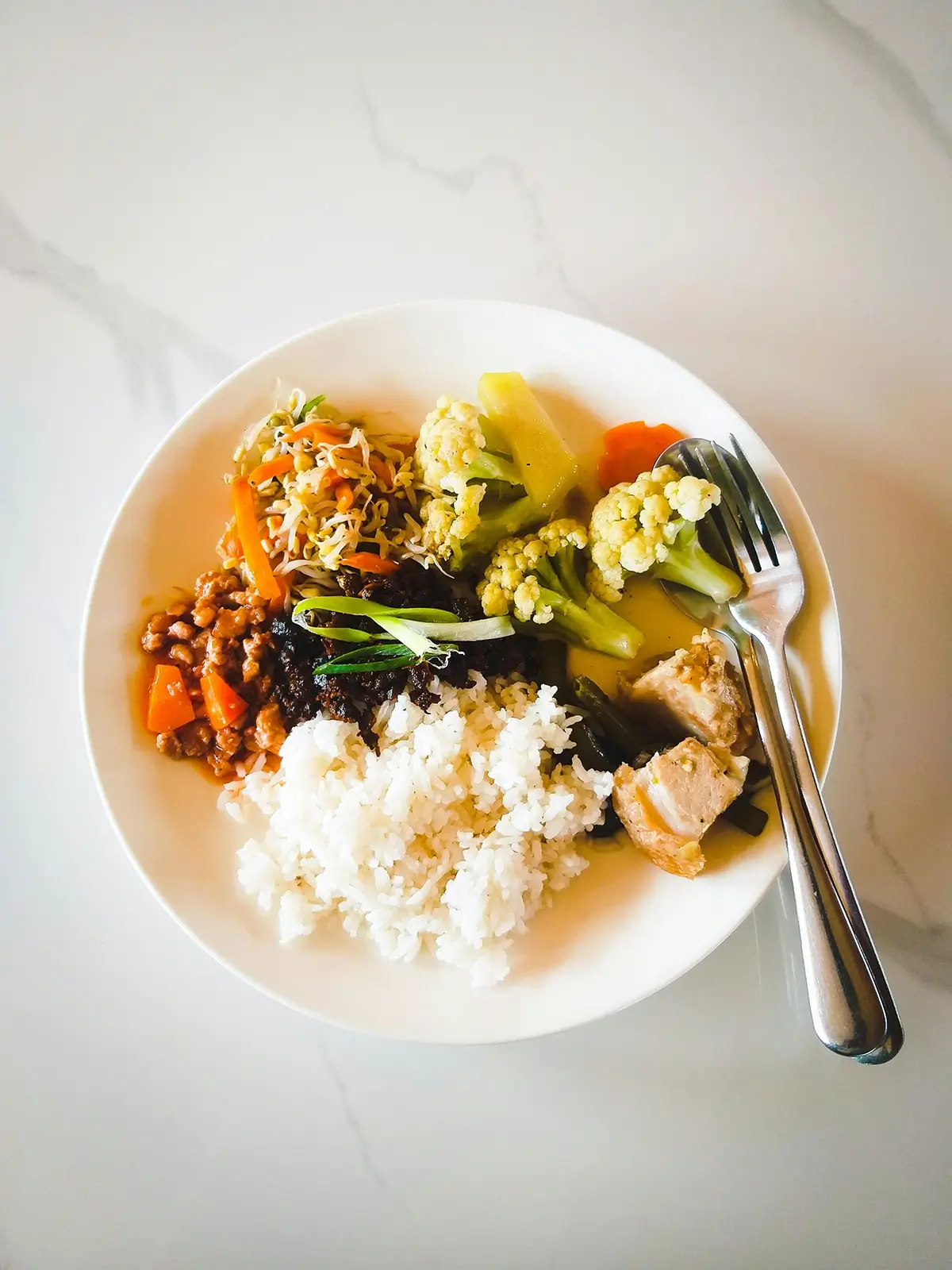
Why am I always so tired after eating?
It’s not always the food, it’s your life around the food
When clients bring this up in sessions, my first question usually isn’t “What did you eat?” It’s “What’s happening around your meals?” Are you sleeping well? Are you skipping meals earlier in the day? Are you standing while eating, rushing to your next task, or underfeeding yourself in the name of being “good”? So often, fatigue after meals is a reflection of your life, not just your plate.
Wendy shared this on the episode for many of the women we work with, fatigue isn’t about one heavy lunch. It’s about caring for everyone else all day, skipping meals while making sure others are fed, and finally grabbing something late in the afternoon. By then, the exhaustion is already there. The meal just brings it to the surface.
Macronutrient balance still matters — but it’s not about cutting carbs
We’re not anti-carb here. In fact, one of the things that can help reduce post-meal fatigue is including enough carbs paired with fat, fiber, and protein. Jess shared a small study that looked at how different macronutrient profiles impacted blood sugar and energy. High-carb meals without much fat or fiber led to faster spikes and crashes in blood sugar, which translated to more fatigue. The takeaway wasn’t “cut carbs.” It was “add other things.”
We see this in our practice all the time. Meals that include balanced portions of protein, carbs, and fats like toast with peanut butter, rice and beans, or smoothies with chia seeds help provide more steady energy, especially for people managing insulin resistance.

Don’t forget hydration and movement
There’s a tendency to blame food for every post-meal slump, but some of the biggest culprits have nothing to do with what’s on your plate. Are you hydrated? Have you moved your body? Are you overstimulated, overwhelmed, or underslept?
Even something as simple as walking in place during that afternoon energy dip can help you feel more alert. We’ve also had clients notice big improvements in fatigue, headaches, even migraines just by drinking more water. Herbal teas, agua frescas, or fruit-infused water can make hydration feel easier and more enjoyable than trying to force down plain water when it’s the last thing you want.
Snacks are not the enemy
If you’re someone who skips breakfast or tries to “be good” during the day, only to crash later you’re not alone. We see this pattern all the time. That afternoon fatigue is often the result of under-eating earlier, not overeating later.
That’s why we recommend keeping easy, nourishing snacks on hand like protein bars, nut butter packets, or trail mix that you can stash at your desk or in your bag. Snacks don’t need to be homemade or perfect. They just need to help you feel steady and supported.

Support your nervous system, not just your nutrition
One thing that came up in this conversation is the connection between the nervous system and digestion. When you’re stressed or in fight-or-flight mode, your body literally struggles to digest food properly. Your stomach might feel tight or nauseous, or meals might leave you feeling depleted instead of energized.
We recently brought a new dietitian, Anna, onto our team who focuses on nervous system regulation. She shared how things like deep breathing, mindfulness, and meal-time pacing can actually help your body absorb and use the food you’re eating more effectively. In my experience as a dietitian, some of the most overlooked interventions for digestive issues aren’t supplements; they’re slow, intentional habits. Sitting down to eat. Chewing well. Taking a few deep breaths before your first bite.
Energy doesn’t come from food alone — it comes from rest
Sometimes feeling tired after eating is just a signal that your body needs rest. Not a new supplement, not a stricter food rule but actual, real rest. That could be a 15-minute nap, a moment of stillness, or an early night. We don’t talk about that enough in diabetes or PCOS care. There’s this idea that if you’re tired, it’s your fault. But the truth is, we’re all living in bodies that are responding to life. Invisible labor, chronic stress, hormonal shifts, parenting demands: those things aren’t fixed with a salad.
So yes, let’s look at how meals are structured. Let’s talk about hydration, movement, blood sugar patterns, and micronutrient balance. But let’s also give ourselves permission to slow down. To stop blaming ourselves. To listen to what our body is saying and honor that with care.
And if you’re navigating this on your own and want support, our team at Diabetes Digital is here. We accept most insurance, and our dietitians can help you feel more in control of your energy, blood sugar, and well-being without the shame or extremes.
Transcript
Why you feel tired after eating, even when you’re doing everything “right”
Diabetes Digital Podcast by Food Heaven
0:00
Welcome back to another episode of the Diabetes Digital Podcast presented by Food Heaven.
Today we’re going to talk about something that comes up a lot and that is why am I so tired after I eat?
Many people will tell us that some meals leave them feeling more tired than energized.
0:18
And in this episode, we’re exploring the real reasons behind post meal fatigue, many of which go beyond just what’s on your plate.
So we’re going to go over everything from the exhaustion that comes with chronic stress to the impact of skipped meals and not eating enough and how those things have an impact on your energy.
0:35
You’ll also learn how food access, timing and gentle tweaks to meals can help your energy without overhauling your entire diet.
So this episode is really going to be packed with insides.
Also practical tips.
So definitely you want to listen until the end.
Welcome to the Diabetes Digital Podcast.
0:51
I’m Wendy.
And I’m Jess, and we’re best friends, registered dietitians and diabetes educators.
Through our telehealth platform, Diabetesdigital.co, we offer accessible and personalized virtual nutrition counseling for people with diabetes and pre diabetes.
Visit diabetesdigital.co that’s Co to book your first appointment.
1:11
We accept insurance and offer affordable self pay options.
Now let’s get into today’s episode.
This podcast is brought to you by Hero Bread is dietitians were always on the hunt for store bought foods that we can confidently recommend to our patients.
1:27
But here is the catch.
Anything we recommend has to actually taste good.
Life is short and I both live to eat and eat to live.
That’s when Hero Bread reached out.
I’d seen them in stores, but I hadn’t picked anything up yet and they had sent a bunch of products for us to try.
1:44
Now, my husband and I, we love food, and we were immediately hooked.
Hero Bread isn’t just tasty, it’s functional too.
Each serving has zero to 2 grams of net carbs, no sugar, and four to 10 grams of protein depending upon the product.
So the Hawaiian rolls, for example, which are new and I love, they have 4 grams of protein per serving.
2:04
It’s perfect for managing blood sugar or adding more protein while eating the bread you love.
Their tortillas are a new favorite in my house.
My husband and I both love using them to make quesadillas as quick snacks.
I’m a big quesadilla girl.
I’ve also been using their bread for sandwiches.
2:19
I love making a sandwich for lunch because it’s easy and it’s filling.
But I am picky about bread.
It has to be the best part.
And here’s the thing.
Sometimes breads with health claims tend to be dry and disappointing.
But not this one.
Hero bread is moist, chewy, and really truly satisfying.
2:38
Their hamburger buns are also perfect for my vegetarian patties, and the extra protein helps me hit my daily protein goals.
Now, whether you’re looking to manage your blood sugar or you just want to enjoy a delicious bread option with added protein and prebiotic fiber, Hero Bread is a simple and tasty option.
2:55
Ready to give it a try?
Visit hero.co to shop their full lineup and use our special coupon code DD10, that’s DD is in Diabetes Digital 10 to get 10% off at checkout.
And don’t forget, they also offer free shipping for orders over $50.
3:11
That’s hero.
HE ro.co.co.
Now, on to the episode before we drop in.
When do you have a question for you?
Do you notice, like, with certain meals, you feel more tired?
Or is there anything like within your life in particular that makes you kind of feel a little more sluggish after you eat?
3:31
Yeah, For me, it’s more like big picture.
Like I would say if I’m not well rested, it kind of impacts the trajectory for the rest of the day.
And so it’s definitely going to affect how I’m feeling post meals, but it might also affect like what I’m eating during the day.
3:48
It kind of has like a domino effect.
And so it’s not particularly like any meal that I’m like, oh gosh, unless it’s of course, like, I don’t know, like a holiday meal or something like that where I just completely overdid it.
But like day-to-day, it usually has to do with something bigger going on with like either stress or sleep or something like that.
4:07
What about you?
I think it’s definitely for me, like kind of what happened that day.
Did I sleep?
If I don’t sleep, it’s over for me.
Yeah.
If I don’t sleep well, I notice also with what I eat, it definitely makes a difference.
I know there’s like a sweet spot for me for like carbs, protein and fat.
4:24
And many people I think that it’s better to eat less carbs.
We’re going to talk more about that.
But I find, and there’s some research to support that having carbs within the right balance and having enough carbs is actually going to make you have a more steady stream of energy, whether or not you are somebody who is experiencing diabetes or pre diabetes.
4:44
So we’ll get more into that.
But yeah, for me, I definitely see like with the meals, when I have that balance, that works really well for me.
I’m feeling better and when I kind of overdo it on one macronutrient, I don’t have as much energy.
I feel tired.
Yeah, it’s really important to assess what is going on because I think it’s different for everyone.
5:04
And I recall in conversations that I would have, especially in clinical settings with people that had children, like something that I used to see all the time is that they would make sure that their children ate, that their partners ate, and they would kind of be last in line.
And sometimes they would be so tired from the day and from cooking that they wouldn’t eat at all.
5:25
And then that would also affect, you know, how they would feel like later in the day when they eventually did eat something.
And so you have to kind of assess what is going on.
Are you overwhelmed with caretaking?
Are you overwhelmed with work, with school?
Like what are the stressors in your life that might also be contributing towards the fatigue?
5:44
You know, it’s really important to kind of take all of that into account, especially if it’s chronic stress because of course, sometimes we have our days where it’s a lot more unbearable than like the typical day.
But if you’re finding that it’s like consistently happening where you’re just feeling fatigued, you’re stressed out around meal times and you really have to get to the bottom of what is going on.
6:06
I remember for us when we were going through our burnout with just like work and trying to figure out like what we were going to do professionally, we did a whole podcast series about this, by the way, on our previous podcast, the Food Heaven podcast, if you’re like, what are they talking about?
6:23
And so I remember during that time, I was exhausted, especially after mealtimes.
And it was definitely related to the uncertainty of work and not really knowing what we were going to be doing and things like that.
6:39
So yeah, I mean, this could come from so many different factors.
So definitely take a pause and try to think about like, what are all the things that are going on during the day, especially around the times that you’re eating?
Like what are the thoughts that you’re typically having?
What is your schedule like?
6:56
Like what is leading up to your meal times and seeing like is there a connection there?
Yeah, I also want to share something.
This is like kind of random, but I think people will appreciate this information.
I just shared it with the dietitians who are part of our practice.
But it just back to like the whole burnout conversation.
7:14
So I was diagnosed with ADHD, I don’t know, maybe like 2 years ago, kind of at the height of my burnout.
And what’s interesting is that since I changed, not changed professions, but kind of change jobs in a sense where we do less, if not no kind of influencing and content creation.
7:38
Since I let that go and focus more just on diabetes, digital clinical work, I feel like my focus is great.
And I’ve even tried ADHD medications and they don’t work for me.
And what’s really interesting is that an article came out, it’s like an hour long article in the New York Times that suggests that ADHD is kind of more environmentally based than just like something that’s innately within you.
8:04
I think it can be both.
But what they’re saying is like if you’re having a hard time focusing or you’re feeling super burned out or all these things, or you know, it’s ADHD diagnosis, like maybe, and this is can’t work for everybody, right?
But like maybe what’s really wrong is there’s not a fit with the environment.
8:20
So that’s another thing to consider.
Just like if you’re feeling burnout, ADHD, can’t focus all these things, maybe you might need to just switch some things around in your life if possible.
Yeah, I think about that a lot with just like different mental health conditions and like being a child of immigrants, how they’re treated so differently in our home countries, like, and of course sometimes it’s like there’s just there’s not the resources there to even understand what’s going on.
8:46
But I think about kids that would typically be diagnosed with like autism or ADHD and how like back in Dominican Republic, it’s very much like a hands on approach, just like cutting down on stimulation, having them be in nature and it makes such a big difference.
9:03
Whereas here the default is medication.
Right.
Yeah.
So different if you.
Have been diagnosed or you know someone that it’s a fascinating article and it goes into like all the research on the medications and it’s just not what we think and potentially we’re treating ADHD all wrong.
9:20
OK, back to blood sugar, how does this connect?
So #1 And this is what we had talked about and we talked about this a lot within our practice and that is trying to have a balance of macronutrients on your plate.
9:35
So I want to illustrate one study that I thought was interesting and it suggested that high carb meals without sufficient protein, fiber or fat can cause blood sugar spikes followed by crashes leading to fatigue.
Now, this was a tiny study, so I wouldn’t make any, you know, blanket recommendations on this, but it’s also consisted with what we see in our practice.
9:56
And so in this study, they had a small group of adults and they gave them a high carb meal that was 120 grams of carbs in that meal, mostly sugar and 8 grams of fat, so pretty high carb.
And then they gave them a high fat meal, which had 54 grams of carbs and lower sugar and 24 grams of fat.
10:15
And they also ate the meals fast, which I think is important to note because mindful eating matters as well.
There’s research to support that, like eating slow, chewing on your food can have an impact.
And what they found was that both meals spiked like glucose and insulin, but the high carb meal spiked them higher and faster.
10:34
So the spike peaked at 30 minutes versus the high fat meal, which led to a slower, smaller glucose and insulin spike.
And that peaked at 60 minutes.
So again, it’s just some information.
It’s a very tiny study, but I think this can suggest that it is really important to try to focus on pairing your carbs with other nutrients instead of cutting your carbs, which is what a lot of people will do when they’re diagnosed with diabetes or pre diabetes.
11:02
So how can you pair your carbs?
One example, add peanut butter to toast.
This is like my favorite bedtime snack.
And also we talked about this in our practice as a snack that works really well for studying blood sugar overnight.
This is something you might want to try if you find that you wake up hungry or your blood sugars are kind of all over the place at night.
11:21
Peanut butter with toast and I do a sourdough toast.
Like doesn’t even necessarily have to be a whole wheat toast.
Like just see how your body responds.
Also include beans with rice, right?
So if you love rice and even white rice, like adding bees is going to add a ton of fiber.
11:37
And one simple thing with the smoothie is incorporating hemp seeds or chia seeds.
Those are going to add some fat and protein, which also will help steady your blood sugar.
Now, what if your blood sugar is already high?
Because this is something that a lot of people, you know, come to us with or we’re monitoring their blood sugar, we’re noticing it’s high.
11:56
Elevated blood sugar can cause fatigue, especially if your cells aren’t using energy efficiently.
So one thing that we recommend people focus on is instead of adding more caffeine, which is a lot, you know, many people’s go to is like, oh, I’m tired caffeine or even instead of adding more food, immediately pause and check.
12:17
Ask yourself, are you hydrated?
Being dehydrated can cause fatigue and also can cause elevated blood sugar.
Have you moved today?
That can cause fatigue.
Where was I, the other?
Oh, I was like at a restaurant and I, we were sitting there waiting for food over the weekend.
12:34
It was taking forever.
And I was like literally about to fall asleep because my blood sugar was crashing.
And that was also because I was just hungry because they were taking forever.
But I was like, OK, let me stay awake in this conversation with friends.
And so I got up and just, you know, did a little, you know, walk in place and that totally helped me feel more energized.
12:52
Also noting do you skip meals or are you under eating earlier?
This is a huge one.
We always talk about, you know, if you find that you’re trying to eat quote good or healthy throughout the day and just eat salads or skip breakfast and then your ravenous later on and then get the itis, then it might be that you’re just not kind of spacing your meals out well and or skipping meals too frequently.
13:21
Yeah, yeah, the hydration 1 is so important.
That reminds me of a patient that I had where she had like massive migraines, a lot of fatigue, and it was week after week.
She would report the same symptoms and she was like ready to see a neurologist.
13:38
And I’m like, after doing an assessment, I’m like, it sounds like you’re not really drinking enough water.
And literally like that made all of the difference.
Just like being hydrated.
All of her symptoms went away.
For some people, it’s not as simple as that, but hydration does make a huge difference.
13:54
And if you’re not a fan of water, you can always do herbal teas.
That’s usually something that I do to start my day, like ginger.
I’ll do ginger, turmeric, like like different types of teas and in the summer it’s nice because you can incorporate fruits like you can do agua frescas like the fruit waters and things like that.
14:12
The movement that just mentioned is really important, especially if you are sitting at your desk for a really long time like I am right now.
I try to get up, you know, every couple of hours and just do a little bit of walking outside.
Getting some sunlight.
Stretching can also help with stress reduction because a lot of times it has it’s nothing to do with food, like we mentioned earlier, like if you have chronic stress, if you’re constantly in fight or flight, that is going to be exhausting and it’s also going to affect your food choices.
14:45
And we all know that your nervous system impacts digestion.
Think about how your stomach feels when you’re like in constant stress.
It in my experience, it’s like your stomach turns into knots.
It just doesn’t feel good.
And so trying to regulate your nervous system is going to help a lot.
15:05
And we actually have a dietitian, Anna, who started with us recently.
And that was something that really drew us to her when we were interviewing her because she said that her focus is like nervous system regulation, which I had never heard about in nutrition.
15:20
And I’m like, Oh my God, that makes so much sense.
It’s such a useful tool to incorporate when you’re, you know, working through nutrition, just like figuring out what is stimulating your nervous, the system and how can you like kind of align that so that your body feels more regulated.
15:39
Yes, and also she’s trained in like deep breathing.
And I think it can be helpful for people who have a lot of food anxiety, but also for digestive issues.
Because I can’t even tell you the amount of times where people are ready to cut everything out and do all these dramatic things.
15:57
And it’s really just they’re not eating consistently and there’s a lot of stress around the meals.
Eating quickly, standing up while eating, rushing while eating and not just taking their time chewing their food.
That works.
I would say 50% of the time is like the main culprit.
One thing I want to add, and I’ll show a clip here for the people who are watching on Spotify because we’re now on Spotify and YouTube video.
16:22
Right.
So I’m holding up, the dietitian shared this with me and it’s been life changing because she was like, you’re not getting enough water.
I now have a picture of water at my desk and I put some ice in it.
16:38
I put a little bit of like electrolytes in there, a little bit of lemon and then I don’t have to like think about it.
It’s also a glass jar, which I find helpful because I was doing water bottles.
But if I can’t see it, I don’t know where I’m at.
And I’m a little bit motivated by like, oh, not drinking all of it because I won’t over drink if I don’t feel it.
16:58
But you know, if I see like, OK, you barely drink any water, girl.
So anyway, that’s one tip that can be helpful, putting it on your desk, especially if you work from home.
In addition to having water accessible, try to have some energy supportive snacks accessible as well.
17:14
So easy to access snacks.
Keep these things in baskets in your car, in your bag, on your work desk.
Examples can be trail mix, nut butter packets, chickpeas, protein bars.
17:29
We really like the RX bars, some of the Clif bars as well.
There’s so many go macro bars and there’s also one of the things I I love recommending and my husband has one a day.
It’s the chomps.
So if you’re someone who eats meat, they are kind of like a beef jerky, but it’s it’s includes 10 grams of protein.
17:49
And yeah, he loves those.
And also like just those little nut packets.
You can get a big box off of Amazon.
So we’ll get a box.
I think it’s like 40 of almonds or sometimes mixed nuts.
And then it’s just kind of individually wrapped in packages.
18:06
Those things really help us make sure to like eat enough.
And also, if you’re on the go and maybe you are, you know, between meals and it’s going to be well until your next meal, instead of letting your energy completely crash, having those snacks on hand can be really helpful.
Another thing I want to point out, because so many people feel like they have to completely overhaul everything they’re doing.
18:28
And oftentimes it’s just about adding.
We’re really big on additive nutrition, not necessarily taking things away.
So add eggs to your toast, add chia seeds to your oatmeal, add avocado to your meals.
That’s going to make a huge difference.
18:44
And especially if you’re wearing a CGM or continuous glucose monitor, you’ll probably notice when you add those things versus don’t have them that your blood glucose is more steady and stable and you’re less likely to have those crashes and feel tired after eating.
And in addition to everything that we’ve covered, I just want to emphasize the importance of rest.
19:05
It’s really important to prioritize REST.
And I know sometimes it can be challenging, especially if you have kids.
If you have a lot going on, it’s like, OK, when am I going to be able to do that?
But it’s going to make all of the difference with how you’re feeling, even how your body is digesting food.
19:23
Like just trying to find those moments of stillness or just moments of sanity where you can go out, get some fresh air.
Figuring out, like, what can help boost your energy outside of food.
And sometimes it’s taking a nap.
19:39
Okay, that does the trick for me most times, you know, just like laying down for 1520 minutes trying to get some shut eye, just like not having all of the simulation of the noise and the this and the that.
That is really important for energy management as well because I do, you know, hear this messaging a lot online of like, oh, you’re doing something wrong if.
20:03
You’re feeling tired, you have to change up everything that you’re eating aside from like the nutrition part, which of course, like there are things that you can tweak there.
It’s like ultimately, if you are emotionally exhausted, if you’re overextending yourself, if you’re not prioritizing rest, and there’s but so much that the nutrition will get you through, right?
20:24
Like you’re still ultimately, you might feel a little bit better, but you’re still going to feel tired because fatigue is a signal that you probably need to slow down.
You know, that you probably have to make sure that you’re taking care of yourself.
So just keeping that in mind.
20:41
Yeah, one of my favorite quotes online from this woman who works in nervous system work is you can’t out supplement A dysregulated nervous system.
And I think that applies to food, to nutrition, all the things like if you’re feeling dysregulated, burnt out, frazzled sometimes, like when you say you just need to sit down, hang out, take a nap.
21:06
Yeah.
Yeah.
OK so in wrapping I think it’s important to not blame ourselves, right?
Stop blaming yourself.
If you’re feeling tired after eating, it doesn’t mean you’re lazy or doing something wrong.
Definitely check out our podcast Laziness doesn’t exist.
21:22
It is a life changing podcast and life changing book.
So good.
Probably one of my favorite episodes.
You may be under fueled, emotionally exhausted, or overextended from invisible labor, which tend to impact us as women a lot, and fatigue is likely a symbol that you may need to slow it down.
21:40
Make sure you’re eating enough and include that hydration on a daily basis.
All right, so thank you so much for tuning in to this episode today.
Make sure that you check us out at diabetesdigital.co.
We have dietitians that can help you if you’re feeling fatigued after your eating meals.
21:57
If you want to regulate your blood sugar, you literally just fill out your information, upload your insurance card, and most of our clients are fully covered by insurance.
So make sure you check out our website and we’ll catch you next time.
Bye bye.
Thanks for joining us for today’s episode.
22:13
If you’re interested in nutrition counseling with one of our expert dietitians to help improve your pre diabetes or diabetes, visit us at diabetesdigital.co.
Also, if you found our conversation helpful, do us a favor and rate and review this podcast on iTunes, plus share with someone who might find this helpful.
22:32
You can also connect with us on Instagram at Diabetes Digital dot.
Co and TuneIn every Wednesday for practical, inclusive and culturally humble diabetes insights.
We’ll catch you later.
Bye.
© 2025 Spotify AB
Legal
Privacy
Cookies





Leave a Reply